Tuesday, 25 March 2014

Rewriting literature in your garden ... or why the best laid plans go awry.

We all sigh over star-crossed lovers.  Romeo and Juliet, Abelard and Heloise, Heathcliff and Cathy, all destined to be apart.  At least, they may be in literature, but not necessarily horticulturally.  I have already mentioned the piece of our garden given over to plants with literary references such as Euphorbia Humpty Dumpty (I didn't say they were always highbrow), and this year we thought that we might change the course of literary history.  We decided to thwart Emily Bronte and grow Heathcliff and Cathy sweet peas, planting them to entwine together, scrambling up a sweet pea wigwam.  Desperate all-consuming passion would be converted into sweet smelling bluey-purple and white blooms.

Happily, we planted our sweet pea seeds individually into root trainers (you did read "Still time for sweet peas", didn't you?), and smugly sat back ready to wipe the smile from Bronte's face.  Eight weeks later, how are we faring?

Twenty four seeds of each were planted. Here are the Heathcliff seedlings.  A success rate of possibly sixty percent or so, which is not brilliant but is reasonable for a relative newbie.  And the Cathy?  Look closely, when you count.

Sweet Pea Heathcliff

Sweet Pea Cathy
Yup.  Two.  If you include the rather diddy runt that is just poking up from the corner of one of the cells. Pathetic!  Just over a five percent success rate!  I realise that Cathy died young, but these haven't even been born!  Heathcliff and Cathy are not destined to be together in a Hurst Green garden this year - or at least, at a ratio of about 7 to 1, not in any way that wouldn't raise some Surrey eyebrows.  We did plant some seeds named for my wife, Jilly, and this places me into a quandary - do I really want Heathcliff and Jilly to be together instead?  Especially since she is, apparently, rather more of a Mr Darcy woman, and doesn't really like Heathcliff anyway.  Round one to Emily Bronte!

So, where did it all go wrong?  In truth, we have no idea.  The packet told us not to soak or chip the seed, and these instructions were obeyed to the letter.  They went into a propagator with the other seeds such as Perfumed Delight and Snoopea, which have all had at least a 60 percent success rate.   Perhaps Sweet Pea Cathy is just difficult to germinate - after all, it is not commonly sold in garden centres, who only tend to stock the easiest all-rounders, and we had to send away for them.  (Incidentally, we also had to send away for Jilly, despite it being listed as one of the best exhibition scented sweet peas in existence - garden centres, what are you doing?).  We shall give Cathy a try again next year, only this time we will soak them in advance.  If we have no luck again, Cathy and Heathcliff will just have to go back to wandering the Yorkshire moors!

Tuesday, 18 March 2014

The first rose of spring ... and it isn't a rose!

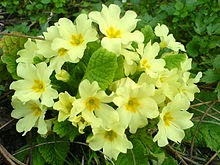
The days are getting longer, and are warming up as well.  We are now well into the first signs that spring has arrived - and in particular, that stalwart of the spring garden, Primula Vulgaris, or the common primrose.  Not so vulgar as it's name suggests, it is also known as the English primrose and tends to bloom with the early daffodils.  It seems unnecessary to give a detailed description for such a plant, but it has a pale yellow single flower with a rosette of rather leathery leaves.   It does occasionally have pink or white flowers in the wild, but the yellow form is very the the "standard" version. That it is such a staple of the spring may be seen in the derivation of it's name, which is from the medieval Latin prima rosa, or "first rose" - even though it has little in common with the actual varieties that we now call the rose.

The common primrose used to be seen growing wild in abundance in its preferred habitat, which is open woods or shaded hedgerows, but it has been over collected (particularly in urban areas) and the swathes of primrose on banks that marked our parents' or grandparents' childhoods are sadly long gone in this part of the country - although occasionally you can see them on motorway or railway embankments where the humans have been unable to reach them, so the roads and rails are good for something at least! It is now illegal to pick the flowers from the wild, or gather the plant from there, and we should all therefore be growing this plant in our gardens as much for conservation in the South as for the pleasure it gives so early in the year.  If you have a cottage style garden, it is indispensable, as it is a staple of the genre.

Go on - have a dance and
surprise a chicken!
The primrose's popularity has also lead to a large bank of folklore about the plant; did you know, for example, that the plant was supposed to have sprung from the body of Paralisos, who was turned into a primrose by his mother Flora after suffering (and possibly dying of) a broken  heart? To be fair, this was so not much of an honour as it might seem, as much the same happened to Narcissus, Hyacinth, Anemone and Crocus, to name but a few.  It is also supposed to be lucky to bring thirteen of the plants into the home, but unlucky to bring in only one! And, if any of you should happen to keep chickens and then see a single primrose, you must dance around the plant three times to prevent bad egg laying ... moreover, April 19th is traditionally known as Primrose Day in honour of the late Prime Minister Benjamin Disraeli, as they were his favourite flowers.

It is an easy plant to keep, preferring moist, well drained acidic soil in partial shade.  It may be propagated by seed, but it will also respond well to division, which should be performed about every two to three years, between September and April.  In a good year, it will keep flowering from February to May, and you will rarely need to buy another again as it will pop up readily from seed.

Please remember as well that we have a class in next month's Spring Challenge show, specifically for a posy of primroses displayed in a wine glass.  A nice way of showing them is to tie the posy with some leaves surrounding the flowers, as this makes a lovely display.

Sunday, 16 March 2014

March meeting 2014 - The Gardens at High Beeches

Mr Russell Yates, the Head Gardener at High Beeches, spoke at our meeting in March, on the topic "The Gardens at High Beeches".   He was somewhat brave, as we were the first club that he has ever given a presentation to, but did not need to worry as the talk was delivered well and was informative and interesting.  We learned that the High Beeches estate was part of the extended family group that included Wakefield and Borde Hill among others, and that the problems of Ash dieback and other garden diseases means that the preferred method of stocking the gardens is through own-garden propagation rather than bringing in duplicates from other sources.  We were also given an idea of the devastation that occurred following the Great Storm in 1987.

Please remember that we are organising a trip to High Beeches and Borde Hill - please let Jane know if you would like to come, but have not yet signed up.  The date should be May 11th (a Sunday).

Wednesday, 12 March 2014

Above and beyond ...

Many Happy Returns arrived at the Club this evening for Jane, who went above and beyond the call of duty when she came to chair tonight's meeting despite it being her birthday!  I'm sure that the company of the members is a wonderful thing, but I can't help thinking that most of us would much have preferred to stay at home with family on our birthdays - with at least one or two little beverages to celebrate.

In recognition of all her hard work for the Club, cupcakes were provided complete with a single candle - only one, of course, as we are all much too well brought up to ask a lady's age ... but what a candle it was!

Happy Birthday was sung by all, and our best wishes to you on what remains of your day.

Thursday, 6 March 2014

March Meeting 2014

Our next meeting is on Wednesday 12th March, as usual at St Agatha's Hall, starting at 8.00 p.m.  Russell Yates will be giving the talk on "The Gardens at High Beeches".

We look forward to welcoming existing, and hopefully new members!

Saturday, 1 March 2014

Be careful what you wish for

It as been a lovely sunny day, after all that rain (and here's hoping it doesn't come back).  The garden has been sadly neglected, but I have finally managed to get back in it and strip the turf for the new annual wildflower "meadow" (or postage stamp, as it appears).  This is being planted around the area that used to house the children's playhouse, and which will house a new greenhouse when we can afford the thing (have you seen how much a decent greenhouse costs nowadays?).  The playhouse was rotting away and was consigned to a skip a few weeks ago, leaving the turf soggy, trod into a morass and generally not pleasant at all.  The children were not upset to see it go, but the cats have not been happy as they used to shelter in it after one of the windows fell out and they could get in and out at will.

And then, to finish a good day, my birthday present from my wife arrived.  It appeared as a flat pack, which is always a bit depressing, and it fell to me - birthday or not - to make up the blasted thing.  I will use the word "thing" for now, as the sequence of photos of the construction unfold and you try to work out what it actually is.

Starting the construction now.  Can you guess what it is?

It's a wooden box.  Or maybe a shed.
What about after the next two stages?  Any the wiser?  It's got lovely steps and even a veranda.


Thought not.  Now, how about with the roof on?


From the front.  Its finished.  Can you think what my present might be? The flap in the front is a clue.


Still not got it?  My present, dear readers, is described on the box as a "chateau pour les chats".  That's right, a cat castle!  Apparently, after they were evicted from the playhouse, She Who Must Be Obeyed decreed that the little darlings must have a replacement. And it's my birthday that's going to provide it.  At least the little scruffballs are using it.


Which leads me on to my disappointment and the title of the piece.  For when your wife tells you that, for your birthday, she is going to invest in a cathouse, a man tends to have a completely different expectation of what that might mean*.  Indeed, be careful with your wishes - for they may come true in a very different way than you think!

* for those with a sheltered upbringing, "cathouse" is an American Wild West term for a house containing a number of ladies, who all have a virtue that is somewhat negotiable for an appropriate fee.

Wednesday, 26 February 2014

Hellebores - tips for growing and cutting

Now is the time to plant Hellebores, to give early spring colour in the garden.  These plants love light shade, typically growing at the edge of deciduous woodland.  They also like well drained but moisture retentive soil.  If you do plant Hellebores now, they should be watered throughout the summer for the first year until well established.

After Care


There are a number of species available, such as niger, odorus, and purpuracens, although many will be hybrids, often of the Oriental variety. For aftercare purposes, they may generally be divided into three types, all of which need slightly different treatment.  Hellebore leaves tend to get rather large and tatty, and also show disease such as black spot as they become older.  A good aftercare regime involves removing the old leaves, which in many cases has the added advantage of displaying the flowers to better effect, while getting rid of the pests and disease that they harbour.  The picture on the right is of my own hellebores, from which I removed the leaves about four weeks ago (admittedly leaving it a bit late, because of all the rain).
  • The first type of Hellebore is the one which carries its leaves on separate stalks to the flowers.  These are easy - in autumn or late winter, as the flowers are starting to show, simply remove all the leaves (and here's a handy hint - do it carefully as it is easy to remove developing flower stalks at the same time.  I tell you this from my own sad, sad experience).  It is a good idea not to compost the leaves as they will harbour leaf spot, pests and other diseases.
  • The second type is the one which carries flowers and leaves on the same stalk.  The leaves need to be left until flowering has finished, when the stems can be cut down.  If a plant is badly infected with leaf spot, all the infected stems can be removed in the autumn, but this will lose the flowers for the coming spring.
  • The final type includes species such as atrorubens, torquatus and some forms of multifidus, odorus and purpurescens.  These naturally die back to the base at various times of the year, so the dead leaves and debris may simply be cleared away.
All that is then left is to give them a light dressing of a general fertiliser such as blood, fish and bone (but not if you have foxes - use an artificial fertiliser instead).  They can also be mulched after pruning with leaf mould or spent mushroom compost.  Do not use well-rotted manure as it tends to promote leaf growth at the expense of flowers.

If you do have leaf / black spot, spraying with two systemic fungicides alternately is a good idea.  Spray twice in autumn and then twice again in early spring when the new shoots are emerging.

Hellebores as cut flowers


In this week's Saturday Telegraph, the sainted goddess Helen Yemm (in her Thorny Problems column) was asked how to transfer cut Hellebore flowers from the garden without them instantly wilting.  This appears to be a problem for most Hellebores, and especially the Oriental hybrids commonly found for sale.  Helen offered three solutions:
  • Simply pick only the flower heads, and float them in a wide, shallow bowl of water.
  • Heat treat the stems.  This is a technique used by flower arrangers for these and other tricky wilting plants such as euphorbias.  Dip the bottom inch (2.5 cm for our younger readers), of each newly cut stem into hot but not quite boiling water, for about 30 seconds. 
  • The third tip came from one of her readers many years ago.  Fill a washing bowl with water, place the cut stem in the water held in your non-dominant hand (ie the left if you are right handed), then crush the stem firmly between the thumb and forefinger about one and a half inches above the cut (again, for our younger readers, 3.5 to 4 cm).  Then cut the stem through the crushed area, while still underwater (that is why you need to crush with your non-dominant hand, so you can wield the scissors with the correct hand and not take off your fingers in the process!).  This apparently removes the airlock which can form and the stems should quickly stiffen.  It can them be transferred to a vase.  Note that it is a good idea to do this as soon as possible after cutting the flowers. 

Saturday, 22 February 2014

Broadview Gardens, Hadlow - Open for the NGS and throughout the year

Hellebores and snowdrop combination at
Broadview Gardens
Broadview Gardens in Hadlow, Kent, is one of the events listed in our latest event flyer (which can be viewed from the link on the right until the next meeting in March 2014).  The gardens are part of Hadlow College, which is a horticultural college, and the gardens are used as a means of teaching for the students as well as providing a destination for interested gardeners to visit. The College is also an RHS accredited centre, offering a range of full and part time qualifications in horticulture, garden management and design.  Although they are open during the year, they are also open for the NGS with guided tours as part of a Hellebore weekend, as the gardens hold the National Collection of Hellebores and Japanese Anemones. There are also a variety of spectacular bulbs such as snowdrops and irises, which are currently in bloom.

Snowdrops en masse at Broadview Gardens
However, Hellebores and Snowdrops are not the only attraction for these gardens, as the teaching element (including the teaching of garden design mentioned above) has led to the creation and maintenance of a number of show gardens.  Students normally build a new garden or regenerate an existing one each year.  There are in fact 10 acres of garden to explore.  We visited this garden at the beginning of this week, and thought that members might like to see some photographs of them, in order to illustrate the variety that is on display.  We would definitely recommend a visit.

And, I might add, there is a very good coffee shop serving breakfasts, light lunches and cakes!

The full address of the gardens is Broadview Gardens, Hadlow College, Tonbridge Road, Hadlow, Kent TH11 0AL.

Italian style garden at Broadview Gardens
Fountain garden at Broadview Gardens

Oriental Style garden at Broadview Gardens

Stone and Water garden, designed to be easy to maintain with year-round enjoyment

Monday, 17 February 2014

Local-ish events February-March 2014

The eagle-eyed among you may have spotted a new leaflet floating around the meetings this year, entitled "A Selection of Local-ish Events".  We are trying to update this each month, with some local events run by the NT, RHS, NGS, and other interesting locations in the area.   Our rough and ready rule-of-thumb is to regard about 25 miles as local!

We have made a permanent link to the latest brochure in our permanent pages section, on the right of the blog. Please click on it to see what is happening around us.

Please let us know what you think, and what sort of events you would like to see!

February meeting 2014 - The History of the NGS

Many thanks go to Mrs Margaret Arnott, who gave us a talk on the History of the National Garden Scheme at our February meeting.  During the talk, we discovered the origins of the term "District Nurse", arising from the founder of the NGS who started a charity in Liverpool following the death of his wife to raise money for home nurses.  He divided the area into "districts", and the term was born.  Mrs Arnott also gave outlines of a number of Surrey gardens open for the "Yellow Book", including her own garden at Heathside, Cobham - which also happens to grace the cover of the Surrey gardens NGS booklet.

Although, as this article goes to press, the full NGS Yellow Book is not yet available, members are recommended to use the NGS website, www.ngs.org.uk, which allows you to search for gardens open at specific times, and/or within a specified radius of home.  The website also carries up-to-date information on garden openings, and is worth checking for changes to advertised times before departure - some gardens have had to close at short notice recently on account of the rain and flooding.  The website also appears in our "Useful Links" section, on the right of the articles.